

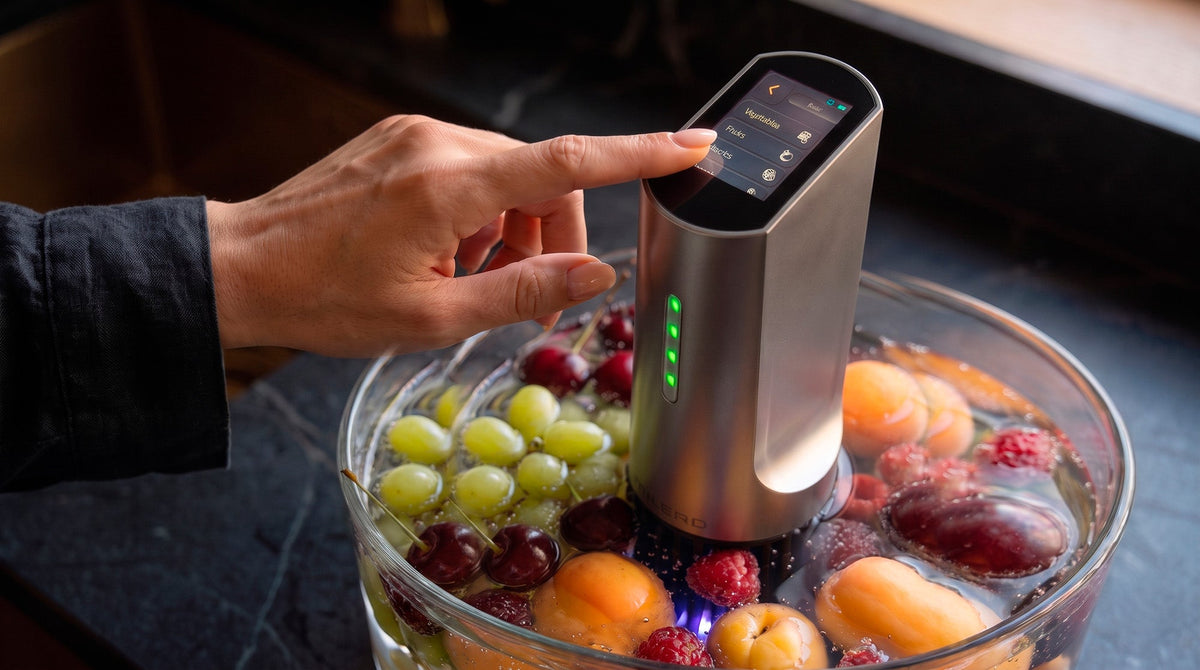
Short answer: some do, within limits. Ultrasound, ozone and electrolyzed water all have published research behind them: ultrasound removed up to about 92% of pesticide residues from leafy greens in lab tests, ozone up to 95%, and combined methods up to 99%. But every method, including every purifier, works only on the surface. Residues that have already moved inside the produce are largely out of reach, and few home devices have been tested independently.
Ultrasound, electrolysis, ozone, and active oxygen have all been studied for cleaning fresh produce. We looked at what each technology can do, where the evidence is strongest, and what remains uncertain.
In 2024, the USDA tested 9,872 food samples, most of them fruit and vegetables, for pesticide residues. According to its Pesticide Data Program, 42.3% had no detectable residues, and more than 99% were below the limits set by the Environmental Protection Agency.
Reassuring, but it doesn't settle the question. Finding a pesticide on an apple doesn't automatically make it unsafe. And a result below the regulatory limit still isn't the same as zero.
At Milerd, we make ultrasonic fruit and vegetable purifiers, so we have an obvious stake in this topic. We've spent a lot of time digging into the research on produce-cleaning technologies, including the one we use ourselves. A few have decades of solid evidence behind them; others are marketed with claims the studies simply don't support. Below is what we found, including the places where the evidence runs out.
How much does washing with water actually remove?
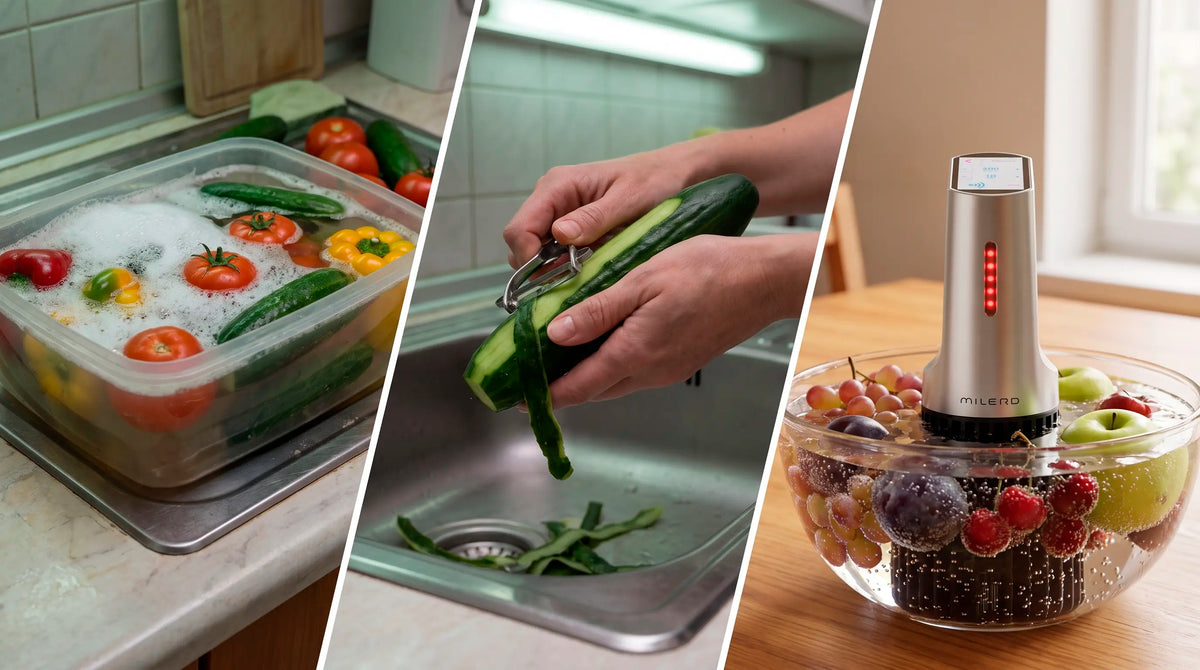
Running water removes surface dirt and reduces both microbial contamination and some pesticide residues. The FDA recommends washing produce under running water while rubbing it gently, and using a clean brush for firm items like melons and cucumbers. Washing lowers bacteria levels, but it doesn't eliminate them. The FDA also advises against soap, detergent, and commercial produce washes, since produce is porous and can absorb them.
There is no reliable universal removal percentage. The result depends on the pesticide, the type of produce, how long the residue has been there, and how long and how vigorously you wash. A 2025 review of 57 studies found that rinsing under running water removed up to 90% of residues in some experiments and far less in others.
The most cited home-washing study came out of the University of Massachusetts Amherst in 2017. Researchers applied two common pesticides, the fungicide thiabendazole and the insecticide phosmet, to organic Gala apples. They then compared tap water, a commercial bleach solution, and a 1% baking soda solution. Baking soda worked best, but it took 12 to 15 minutes of soaking to clear the surface residues completely. A two-minute wash did much less.
The more important finding was what no wash could reach. Within 24 hours, 20% of the thiabendazole and 4.4% of the phosmet had already moved into the apple. Thiabendazole is a systemic pesticide, designed to be absorbed by the plant, and it penetrated about four times deeper into the peel.

Keep that in mind through the rest of this article. Every washing method, including every purifier, works on the surface. Residues that have moved inside the produce are largely out of reach.
Ultrasound
How it works. An ultrasonic transducer sends high-frequency pressure waves through water. These waves create microscopic bubbles that form and collapse thousands of times per second, a process called cavitation. Each collapse releases a tiny jet of energy that knocks particles and residues off surfaces, including folds and crevices your fingers can't reach. It's the same principle used to clean jewelry, dental tools, and lab glassware. Cavitation can also produce small amounts of reactive molecules that break down some compounds.

What the evidence shows. In lab studies, ultrasound usually beats soaking in plain water, but how much depends heavily on the produce. A 2017 study from China tested optimized ultrasonic cleaning on several vegetables. Removal reached about 92% for bok choy and spinach and 90% for green peppers, but stayed below 30% for carrots and white radish. Leafy and smooth-skinned produce responded well; root vegetables did not.
Pesticide removal with optimized ultrasonic cleaning, by vegetable
Source: Chinese Agricultural Science Bulletin, 2017. Lab conditions with controlled pesticide application.
The same research group found that more isn't always better. For leafy greens, the best results came at moderate power with a wash of about 5 minutes. Pushing power above 100 W or washing much longer began to reduce vitamin C content.
Ultrasound also seems to make other cleaning methods work better. A 2025 systematic review of 38 studies found it had the strongest synergistic effect of any technique when combined with other treatments.
What's uncertain. Results depend on power, frequency, wash time, water temperature, and the shape of the produce. Most studies use lab equipment with carefully measured output. Consumer devices vary widely, and many manufacturers don't publish these specifications at all.
Our view. This is the technology we build our purifiers around, so we'll be direct about its limits. Ultrasound is a good fit for leafy greens, berries, grapes, and anything with texture that rubbing can't clean properly. It doesn't replace rinsing, and it won't pull out residues that have already been absorbed.
Electrolysis
How it works. Running an electric current through water that contains dissolved salts produces electrolyzed water. Depending on the setup, it can contain hypochlorous acid, the same active compound found in diluted chlorine sanitizers. The food industry uses several types: acidic, slightly acidic (pH 5 to 6.5), and neutral electrolyzed water.
What the evidence shows. For killing bacteria, the industrial evidence is solid. Electrolyzed water has been studied for years as an alternative to chlorine washes in produce processing. In one industrial-scale study, slightly acidic electrolyzed water combined with two other food-safe agents reduced E. coli O157:H7 and Listeria on apples, mandarins, and tomatoes by roughly 2.9 to 5.4 log units in lab tests, which means somewhere between 99.9% and over 99.999% fewer bacteria. The evidence for pesticide removal is much thinner.
What's uncertain. Industrial systems are built to produce a specific, measured concentration of active chlorine. Small home devices often aren't. How much hypochlorous acid they generate depends on the minerals in your tap water, the current, and the wash time, and few have been independently tested. Be cautious with demonstrations where the water turns yellow or brown during a cycle. That color can come from the electrodes themselves and from minerals in the water reacting, not necessarily from anything removed from the food.

Ozone
How it works. Ozone (O3) is a powerful oxidizer. When it dissolves in water, it damages microbial cells and breaks down many pesticide molecules into simpler compounds. The FDA has allowed ozone as an antimicrobial agent in food processing, in both gas and water form, since 2001.
What the evidence shows. Ozone is one of the most researched technologies for pesticide degradation on produce, with several review papers on the subject. The 2025 review of 57 studies reported removal of up to 95% in ozonation experiments. Researchers have also found that low ozone levels have little effect on the look, taste, and texture of produce.
What's uncertain. Effectiveness depends on ozone concentration, contact time, water temperature, pH, and the specific pesticide. Ozone dissolves poorly and breaks down quickly, so the concentration a home device actually delivers into the water is rarely measured. Researchers also point to an unresolved question: when ozone breaks down a pesticide, some of the byproducts may themselves be toxic. Finally, ozone gas irritates the lungs, so any device that releases it should be used in a well-ventilated space.
Active oxygen
"Active oxygen" is a marketing term, not a scientific one. Depending on the brand, it can mean ozone, hydroxyl radicals, hydrogen peroxide, or simply water with extra dissolved oxygen. These behave very differently.
If a product description says "active oxygen" without explaining what the device produces and at what concentration, there's no way to connect it to published research. It's worth asking the manufacturer directly. If the answer is ozone, everything in the section above applies.
Purifier technologies compared
| Technology | Evidence is strongest for | Highest reported pesticide removal | Main caveat |
|---|---|---|---|
| Ultrasound | Leafy greens, berries, textured produce | ~92% (leafy greens) | Weak on root vegetables; device output rarely published |
| Electrolysis | Killing bacteria (industrial) | Evidence much thinner | Home devices rarely tested; colored water is not proof |
| Ozone | Degrading pesticides, microbes | up to 95% | Real concentration rarely measured; byproducts; ventilation |
| "Active oxygen" | Depends on what it actually is | Not definable | Marketing term; ask what the device produces |
| Combined methods | Most consistent results | up to 99% | Lab conditions, high initial contamination |
Figures from the 2025 review of 57 studies (Meghlaoui et al.) and the 2017 ultrasonic study listed in Sources.
Do combined methods work better?
Generally, yes. In the 2025 review of 57 studies, combined approaches that paired washing with ultrasound and ozonation reached removal rates of up to 99%, the highest of any category. Peeling removed surface residues completely, though it also removes much of the fiber and many of the nutrients concentrated in the skin.
The 2025 systematic review of 38 studies reached a similar conclusion: combinations consistently outperformed single methods and gave more predictable results. It also noted that simple, conventional washing achieved considerable removal on its own, just with more variation from study to study.
What the science still can't tell us
The research on all of these technologies shares some limitations.
- Lab conditions aren't kitchen conditions. Most studies apply pesticides to produce in high, controlled amounts, then measure removal with specialized equipment. Real produce carries a mix of residues at much lower levels.
- Percentages are relative. "Removes 90%" says nothing about how much was there to begin with. Given that most US produce tested falls far below regulatory limits, the absolute difference a purifier makes for a typical apple is hard to quantify.
- Few consumer devices have been tested independently. Most published research uses lab or industrial equipment, not the products sold for home kitchens.
- Effects on nutrients need more study. Aggressive treatments can reduce vitamin content, and the long-term picture is still incomplete.
How to read purifier claims
Before trusting a number like "removes 99% of pesticides," look for answers to four questions:
- Which contaminant, on which produce? A result for one pesticide on lettuce doesn't transfer to a different pesticide on carrots.
- Compared to what? A meaningful test compares the device to plain running water, not to doing nothing.
- Who tested it? An independent lab report or a published study carries more weight than an in-house video.
- What does the device actually produce? Power and frequency for ultrasound, chlorine or ozone concentration for the others. If the manufacturer can't say, treat the claim with caution.
Our take
A good purifier can make washing more thorough and more consistent, especially for leafy greens, berries, grapes, and other produce that's hard to clean by hand. That's a real benefit, and it's the one we design for.
What a purifier can't do is make produce sterile, reach residues that have been absorbed into the fruit, or replace basic kitchen hygiene. A sensible routine looks like this:
- Rinse produce under running water.
- Run a purifier cycle for anything with folds or a delicate surface.
- Rinse again with clean water.
- Dry with a clean cloth or paper towel. Peel when it makes sense for the food.

That's less dramatic than "removes 99.9% of toxins." It's also what the evidence supports.
Sources
- USDA Agricultural Marketing Service. Pesticide Data Program Annual Summary, Calendar Year 2024 (published January 2026).
- US Food and Drug Administration. 7 Tips for Cleaning Fruits, Vegetables.
- Yang T. et al. (2017). Effectiveness of Commercial and Homemade Washing Agents in Removing Pesticide Residues on and in Apples. Journal of Agricultural and Food Chemistry, 65(44), 9744–9752.
- Removing Pesticide Residues in Different Vegetables with Ultrasonic Cleaning Method (2017). Chinese Agricultural Science Bulletin, 33(2), 132–137.
- Removing Carbamates Pesticide Residues from Leafy Vegetables with Ultrasonic Washer (2016). Chinese Agricultural Science Bulletin.
- Efficiency of combined techniques in pesticide residues removal from food: a systematic review (2025). Food Production, Processing and Nutrition.
- Meghlaoui Z. et al. (2025). A Comprehensive Review of Pesticide Elimination Methods from Fruits and Vegetables Over the Past Two Decades.
- Chen X. et al. (2019). Disinfection Efficacy of Slightly Acidic Electrolyzed Water Combined with Chemical Treatments on Fresh Fruits at the Industrial Scale. Foods, 8(10), 497.
- Wang S. et al. (2019). Effects of ozone treatment on pesticide residues in food: a review. International Journal of Food Science & Technology.
- Glowacz M. et al. (2015). The use of ozone to extend the shelf-life and maintain quality of fresh produce. Journal of the Science of Food and Agriculture.
- US Code of Federal Regulations, 21 CFR 173.368 (ozone).

Leave a comment
This site is protected by hCaptcha and the hCaptcha Privacy Policy and Terms of Service apply.