

Ozone is a powerful natural oxidizing agent widely used in water treatment and food processing technologies. But if ozone can be harmful when inhaled, is it safe to use in a household device?
To answer this question, it's important to understand how ozone works, what happens when it enters water, and why ozone dissolved in water is different from ozone in the air.
What Is Ozone?
Ozone (O₃) is a form of oxygen made up of three oxygen atoms. Unlike the oxygen we breathe (O₂), which contains two atoms, ozone has an additional oxygen atom that makes it highly reactive.

This means ozone readily interacts with other substances through a process called oxidation.
This property makes ozone useful in water purification and food treatment technologies. However, ozone can also irritate the respiratory system when inhaled at elevated concentrations.
The key to using ozone technology safely is controlling exposure.
How Does Ozone Work in Milerd Detoxer?
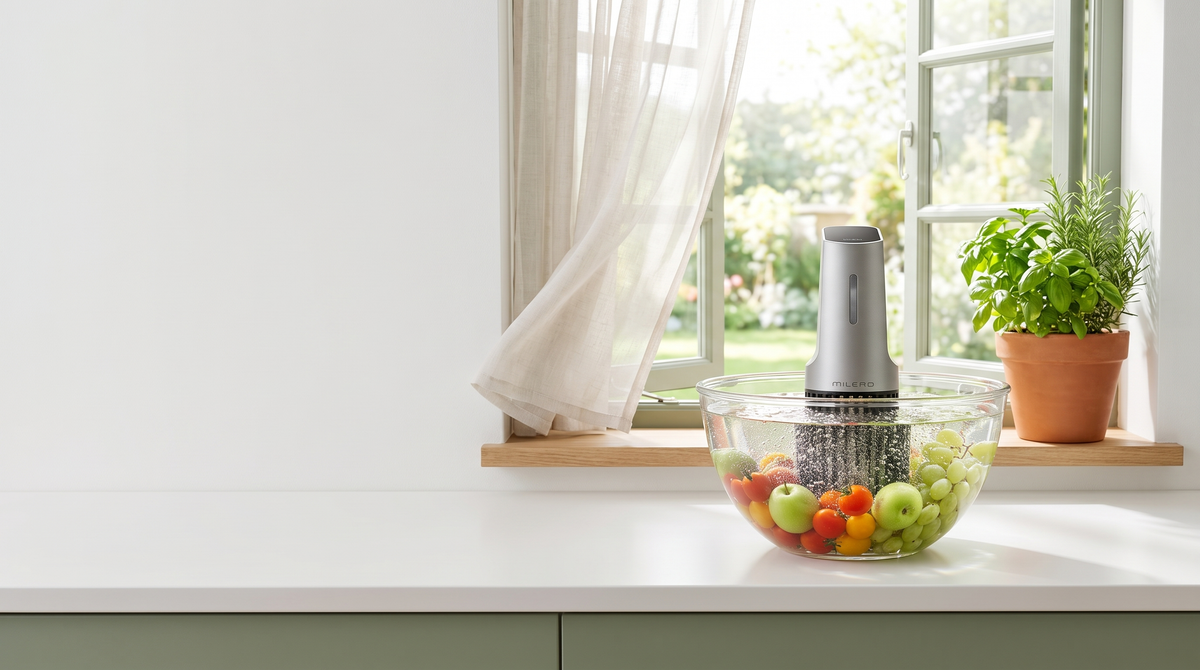
Milerd Detoxer uses ozone technology to treat fruits, vegetables, and other food products placed in water.
Here's how the process works:
- Ozone generation. The device converts oxygen (O₂) into ozone (O₃).
- Ozone enters the water. The generated ozone is introduced into the water, where a portion of it dissolves.
- Oxidation begins. Dissolved ozone reacts with susceptible substances in the water and on the surface of food products.
- Ozone breaks down. As ozone reacts, it is consumed. The remaining ozone gradually decomposes, ultimately forming ordinary oxygen (O₂).

This process allows ozone's oxidizing properties to be used directly in the water surrounding the food.
Why Is Ozone in Water Different From Ozone in Air?
The difference lies in how ozone interacts with its surroundings.
When ozone dissolves in water, it can react with substances present in that water or on the surface of submerged food.
In the air, however, ozone can be inhaled. At sufficiently high concentrations, it can irritate the respiratory system.

It's important to understand that introducing ozone into water does not mean that all of it stays dissolved. Some ozone may escape into the surrounding air.
For this reason, ozone-based devices must be evaluated not only for their effectiveness in water treatment but also for the amount of ozone released into the air during operation.
Why Does Ozone Have a Noticeable Smell?
Ozone has a distinctive, sharp smell that people can detect even at relatively low concentrations.
You may recognize a similar smell around certain electrical equipment.

However, smelling ozone does not automatically mean the concentration is dangerous, just as the absence of a noticeable smell does not guarantee that the air is safe.
The human sense of smell is not a reliable way to measure ozone exposure. Actual concentrations must be determined through appropriate testing.
What Happens to Ozone After Treatment?
One of ozone's defining characteristics is that it is unstable.
Unlike many persistent chemical compounds, ozone gradually breaks down through chemical reactions and natural decomposition.
In water, ozone reacts with substances it encounters and decomposes over time. One of the final products of this process is ordinary oxygen.
How quickly ozone breaks down depends on several factors, including water temperature, water composition, and the initial ozone concentration.
This means ozone does not remain indefinitely in its original form, although the time required for it to dissipate can vary.
Understanding Ozone Safety
Ozone is used in a variety of established applications, including water treatment and certain food-processing operations.
Its effectiveness comes from its strong oxidizing properties. At the same time, those properties make it important to control ozone exposure.

For household ozone technologies, several factors matter: the amount of ozone generated, how it interacts with water, how much escapes into the surrounding air, and how the device is operated.
Using ozone technology responsibly means understanding these factors and following the manufacturer's operating instructions.
Final Thoughts
Ozone is a powerful form of oxygen with useful applications in water and food treatment.
In Milerd Detoxer, ozone is introduced into water, where it can participate in oxidation reactions with substances present in the water and on food surfaces. Over time, ozone is consumed or decomposes, ultimately forming ordinary oxygen.

The important distinction is that ozone's usefulness in water treatment does not eliminate the need to control ozone exposure in the air.
Understanding how the technology works is the first step toward using it responsibly and confidently.


Laisser un commentaire
Ce site est protégé par hCaptcha, et la Politique de confidentialité et les Conditions de service de hCaptcha s’appliquent.